DLP technology
is a revolutionary display solution for video projectors that uses an optical semiconductor
to manipulate light digitally. It’s also a proven and dependable
technology preferred by leading electronics manufacturers worldwide,
with more than 1 million systems shipped since 1996.
DLP technology
is in use wherever visual excellence is in demand. In fact, it’s
the only display solution that enables movie video projectors, televisions,
home theater systems and business video projectors to create an entirely
digital connection between a graphic or video source and the screen
in front of you.
The result is
maximum fidelity: a picture whose clarity, brilliance and color
must be seen to be believed.
The
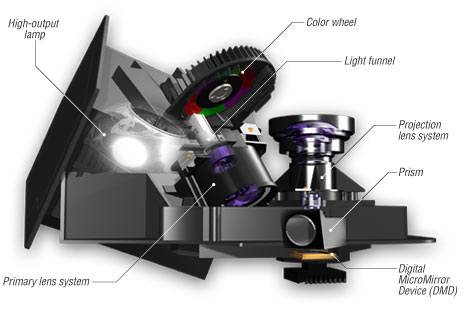
DLP Light Engine
How does DLP Technology work?
The story begins
with a breakthrough in micro engineering-and ends with the best
picture quality money can buy.
The semiconductor
that changed everything
Digital
Light Processing I: the grayscale image
Digital
Light Processing II: adding color
Applications
and configurations
1. THE SEMICONDUCTOR THAT CHANGED EVERYTHING
At the heart
of every DLP projection system is an optical semiconductor known
as the Digital Micromirror Device, or DMD chip, which was invented
by Dr. Larry Hornbeck of Texas Instruments in 1987.
The DMD chip
is probably the world's most sophisticated light switch. It contains
a rectangular array of up to 1.3 million hinge-mounted microscopic
mirrors; each of these micromirrors measures less than one-fifth
the width of a human hair, and corresponds to one pixel in a projected
image.
When a DMD chip
is coordinated with a digital video or graphic signal, a light source,
and a projection lens, its mirrors can reflect an all-digital image
onto a screen or other surface. The DMD and the sophisticated electronics
that surround it are what we call Digital Light Processing technology.
2.
DIGITAL LIGHT PROCESSING I: THE GRAYSCALE IMAGE
A DMD panel's
micromirrors are mounted on tiny hinges that enable them to tilt
either toward the light source in a DLP projection system (ON)
or away from it (OFF)-creating a light or dark pixel on the projection
surface.
The bit-streamed
image code entering the semiconductor directs each mirror to switch
on and off up to several thousand times per second. When a mirror
is switched on more frequently than off, it reflects a light gray
pixel; a mirror that's switched off more frequently reflects a darker
gray pixel.
In this way,
the mirrors in a DLP projection system can reflect pixels in up
to 1,024 shades of gray to convert the video or graphic signal entering
the DMD into a highly detailed grayscale image.
3.
DIGITAL LIGHT PROCESSING II: ADDING COLOR
The white light
generated by the lamp in a DLP projection system passes through
a color wheel as it travels to the surface of the DMD panel. The
color wheel filters the light into red, green, and blue, from which
a single-chip DLP projection system can create at least 16.7 million
colors. And the 3-DMD chip system found in DLP Cinema projection
systems is capable of producing no fewer than 35 trillion colors.
The on and off
states of each micromirror are coordinated with these three basic
building blocks of color. For example, a mirror responsible for
projecting a purple pixel will only reflect red and blue light to
the projection surface; our eyes then blend these rapidly alternating
flashes to see the intended hue in a projected image.
4.
APPLICATIONS AND CONFIGURATIONS
1-CHIP
DLP PROJECTION SYSTEM
Televisions,
home theater systems and business video projectors using DLP technology
rely on a single DMD chip configuration like the one described above.
White light
passes through a color wheel filter, causing red, green and blue
light to be shone in sequence on the surface of the DMD. The switching
of the mirrors, and the proportion of time they are 'on' or 'off'
is coordinated according to the color shining on them. The human
visual system integrates the sequential color and sees a full-color
image.
3-CHIP DLP PROJECTION SYSTEM
DLP technology-enabled
video projectors for very high image quality or high brightness applications
such as cinema and large venue displays rely on a 3-DMD-chip configuration
to produce stunning images, whether moving or still.
In a 3-chip
system, the white light generated by the lamp passes through a prism
that divides it into red, green and blue. Each DMD chip is dedicated
to one of these three colors; the colored light that each micromirror
reflects is then combined and passed through the projection lens
to form a single pixel in the image.
Beautiful Picture
CLARITY
DLP technology
comes closer than any other display solution to reproducing the
exact mirror image of its source material. That's why images projected
by DLP technology are always crystal clear.
The thousands
of mirrors making up the Digital Micromirror Device at the heart
of DLP technology are spaced less than one micron apart, resulting
in a very high "fill factor." By minimizing the gaps between
pixels in a projected image, DLP projection systems create a seamless
digital picture that's sharp at any size-without the pixellation
or "screen door" effect apparent in other technologies.
BRIGHTNESS
DLP projection
systems outshine the alternatives because, being mirror-based, they
use light more efficiently.
While other technologies lose a certain amount of light in transit,
the microscopic mirrors in a DLP projection system bring more light
from lamp to screen.
The difference
is plain to see. With DLP technology, home entertainment becomes
the visually stunning experience it should be. Business presentations
have maximum impact-whether the lights are on or off. And large
venue displays captivate their audiences with outputs of up to a
whopping 15,000 lumens.
COLOR
DLP technology
reproduces a range of colors up to eight times greater than that
of analog projection systems.
In televisions and home theater systems, DLP projection creates
rich blacks and darker shades than is possible with other technologies.
At the movies, DLP Cinema technology projects no fewer than 35
trillion colors-over eight times more than is possible with film.
DLP color is
becoming even more brilliant as we introduce Sequential Color Recapture
or SCR, an innovation that will enable DLP projection systems
(video projectors) to
bring up to 40 percent more lumens to the screen than was previously
possible.
Smarter Product
DESIGN
The Digital
Micromirror Device at the core of DLP technology can modulate light
much more quickly than other display ingredients. That means a DLP
projection system only requires one panel, while other technologies
require three.
The result is
a projection subsystem that is smaller and lighter, leaving ample
room for innovative design. So product designers can focus on making
their products lighter, slimmer, and more elegant.
Think wide-screen
televisions that don't eat up the living room. A new generation
of cabinet-sized, 40-inch tabletop TVs. And portable projectors
weighing as little as two pounds that are bright enough for lights-on
presentations.
RELIABILITY
DLP technology
makes video projectors, home theater systems, and televisions more robust
and more reliable.
The digital
nature of DLP technology means that, unlike other display solutions,
it's not susceptible to heat, humidity, or vibration-environmental
factors that can cause an image to degrade over time.
DLP projection
systems display an original-quality picture time and time again
with zero hassle and minimal maintenance. And with more than one
million systems shipped since 1996, DLP technology has a proven
track record for outstanding dependability.
VERSATILITY
DLP projection
brings the same peerless visual standard to entertainment, work,
and play.
Innovation and flexibility: As far as we're concerned, you can't
have one without the other.
DLP technology
fits into your life wherever visual experience is important. DLP
technology delivers stunning images in your home, while DLP Cinema
technology delivers unmatched image quality in the movie theater.
The video projector you use for presentations also works its magic in
your living room-or even doubles as the ultimate PC game enhancer
for your kids (if they're lucky). And the all-digital nature of
televisions and home theater systems featuring DLP technology makes
them ideal for enjoying television programming, the Internet, and
gaming applications all in one place.
Digital MicroMirror
Device (DMD)
Digital MicroMirror Deviceor
DMD consists of hundreds-of-thousands of tiny actuated mirrors,
each of which is responsible for directing a single pixel to the
screen. This direct pixel-for-pixel relationship ensures a sharp,
highly-accurate picture.
Digital Light Processing
(DLP), Digital Micro Mirror Device (DMD) are trademarks of Texas
Instruments, Inc.